COLLECTING IN THE SOLOMONS -- JUNE 1996
(Or No Wonder Gene Came Home With a Grin on His Face!)
by Gene Everson
If you are like me, you find it
disappointing to read about a shell trip to a wonderful sounding marine area,
only to find it is 90% about the country, and the other 10% is about all the
money cowries or tulip shells that were found. I want to use my 90% to tell you
about the shells I found -- those that would appeal to me, and hopefully to you.
 In June, 1996, I went on a collecting trip to the
Solomons. Our group included Wayne Harland, Homer Rhode, Karlynn Morgan and
myself. We arrived at Honiara, Guadalcanal, the capital of the Solomons, on June
9th. We boarded the Wyuna, with Brian and Mary Claire Bailey, and we
began collecting that same day. Snorkeling near the mouth of the Lungga River in
very poor visibility, on dark sand, we found Conus monachus at 10' and
deeper under rocks, and in the open, C. figulinus, Thais
buccinea on a silty log, and Oliva vidua. That night, using SCUBA
at 50-65' depth, we collected Terebra commaculata at the end of a sand
trail, and Murex tenuirostrum, Cypraea onyx melanesiae and
Oliva rufula, all in the open. A second dive that night off the Honiara
Airport, starting at about 100' and working up to 15' on a silty slope, yielded
Conus hopwoodi, C. betulinus, Strombus marginatus septimus, Cymatium
gutturnium, Trigonostoma obliquata, Glycymeris reevei, Phalium areola, P.
bisulcatum, pretty Natica undulata, N. alapapilionis and N.
vitellus. Oddly enough, whenever we found Conus betulinus, it had
another species on its back, Trigonostoma obliquata, for instance. The
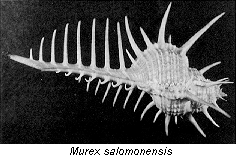
Phalium areola was crabbed. We also found Murex salomonensis
and M. tenuirostrum, but I won't mention them again, because we found
them at many sites at night.
In June, 1996, I went on a collecting trip to the
Solomons. Our group included Wayne Harland, Homer Rhode, Karlynn Morgan and
myself. We arrived at Honiara, Guadalcanal, the capital of the Solomons, on June
9th. We boarded the Wyuna, with Brian and Mary Claire Bailey, and we
began collecting that same day. Snorkeling near the mouth of the Lungga River in
very poor visibility, on dark sand, we found Conus monachus at 10' and
deeper under rocks, and in the open, C. figulinus, Thais
buccinea on a silty log, and Oliva vidua. That night, using SCUBA
at 50-65' depth, we collected Terebra commaculata at the end of a sand
trail, and Murex tenuirostrum, Cypraea onyx melanesiae and
Oliva rufula, all in the open. A second dive that night off the Honiara
Airport, starting at about 100' and working up to 15' on a silty slope, yielded
Conus hopwoodi, C. betulinus, Strombus marginatus septimus, Cymatium
gutturnium, Trigonostoma obliquata, Glycymeris reevei, Phalium areola, P.
bisulcatum, pretty Natica undulata, N. alapapilionis and N.
vitellus. Oddly enough, whenever we found Conus betulinus, it had
another species on its back, Trigonostoma obliquata, for instance. The
Phalium areola was crabbed. We also found Murex salomonensis
and M. tenuirostrum, but I won't mention them again, because we found
them at many sites at night.
 The next day was spent traveling; we anchored for the night
and dove at Vulalua Island. The depth was 35' on a silty bottom. We collected
Harpa amouretta out on the sand, crawling with its wide, fleshy foot,
Strombus labiosus, Bursa tuberosissima and B. rana. Conus
pohlianus (which the latest cone book calls C. consors form
pohlianus) and an unusually marked C. leopardus with markings
much larger and fewer than normal were both at the base of a small reef on sand
at about 30'. The following morning, some of us walked on exposed flat reef
along the shoreline. Thais tuberosa was abundant and I found my first
Turbo sparverius and a large, 81mm Asaphis violascens.
The next day was spent traveling; we anchored for the night
and dove at Vulalua Island. The depth was 35' on a silty bottom. We collected
Harpa amouretta out on the sand, crawling with its wide, fleshy foot,
Strombus labiosus, Bursa tuberosissima and B. rana. Conus
pohlianus (which the latest cone book calls C. consors form
pohlianus) and an unusually marked C. leopardus with markings
much larger and fewer than normal were both at the base of a small reef on sand
at about 30'. The following morning, some of us walked on exposed flat reef
along the shoreline. Thais tuberosa was abundant and I found my first
Turbo sparverius and a large, 81mm Asaphis violascens.
We left Guadalcanal and crossed over to the Florida Islands group. Killing
time 'til dark, we snorkeled at Nuggu Island, where we found Conus
episcopatus under a rock, and several common species such as Cypraea
arabicula. Our night dive, at Mandoleana Island, yielded Fusinus
colus at 90' on sand, Chicoreus paini and C. axicornis
both crabbed on the sand and rubble slope, and a Harpa harpa at 55' on
sand. A Cypraea cribraria was at 10' on a coral head, and Conus
ammiralis was at 90' while C. planorbis appeared at 20' on the
side of a log in algae.
We dove Mbungana Island the night of June 12, on a sloping reef with sand and
rubble and coral heads, to find Turridrupa cerithium on reef sand and
one of the prettiest of all turrids, Turris spectabilis at 47' on a
small rock. Also found Latirus gibbulus in sand and rubble, the lovely
Nassarius glans at 27' on reef sand and a 99mm crabbed Cymatium
pileare. On the 13th, we snorkeled in a small lagoon at Aviavi Island. I
found a 107mm Mitra mitra nearly buried. I spotted a fleck of orange
and fanned it up. Common, but excellent, specimens of Tectus conus
(66mm) and T. triserialis (42mm) were at 6-8' on coral heads, and my
first Spondylus varius was attached to dead coral.
That night we dove the unique Mboli Passage, on Nggela Island. About the
width of a freshwater stream and sporting a current requiring a drift dive
holding rope attached to the boat, this passage provides several habitats on a
single dive. You can encounter sand with delicate soft corals, silty mud, coral
reef areas, or gravel bottom, all coming by you very quickly in poor visibility.
Among the soft corals were Cypraea bregeriana, C. onyx melanesiae,
Margovolva bimaculata, and Volva volva. On the sand was Murex
pecten, Conus acutangulus, Architectonica perspectivum and Gyrineum
pusillum. On the mud was Placomen calophyllum.
 On the 14th we snorkeled off Siota, the small village
where the Mboli Passage empties into the sea. There were Conus stramineus,
C. leopardus, C. striatellus, black C. marmoreus and C.
magus, as well as a crabbed Voluta rutila and a lovely white
crested tellin, Tellina capsoides, all on sand. Wayne found a pair of
Ovula ovum which he photographed and returned to their coral head. That
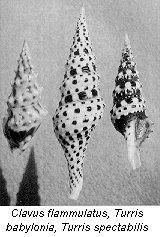
night we dove and snorkeled at Siota. I collected Turris babylonia and
another turrid I had hoped to get, Clavus flammulatus, at 8' on sand
and rubble, a pair of nice Pterygia fenestrata at 8' in sand trails,
Harpa major and Pyramidella acus. Mitra eremitarum
was on a coral head feeding on a worm inside the coral. Its proboscis was
extended so far I had to break it to pull the mollusk off. I also took a live
86mm Cymbiola rutila with SCUBA at 45' on sand and rubble there.
On the 14th we snorkeled off Siota, the small village
where the Mboli Passage empties into the sea. There were Conus stramineus,
C. leopardus, C. striatellus, black C. marmoreus and C.
magus, as well as a crabbed Voluta rutila and a lovely white
crested tellin, Tellina capsoides, all on sand. Wayne found a pair of
Ovula ovum which he photographed and returned to their coral head. That
night we dove and snorkeled at Siota. I collected Turris babylonia and
another turrid I had hoped to get, Clavus flammulatus, at 8' on sand
and rubble, a pair of nice Pterygia fenestrata at 8' in sand trails,
Harpa major and Pyramidella acus. Mitra eremitarum
was on a coral head feeding on a worm inside the coral. Its proboscis was
extended so far I had to break it to pull the mollusk off. I also took a live
86mm Cymbiola rutila with SCUBA at 45' on sand and rubble there.
The next day. the 15th, we snorkeled Anuha Island and found common species.
That night we dove there and I found Polinices maura, the only black
Polinices I can think of, with a white animal. A 90mm Mitra
papalis was at 30' on reef top rubble, as well as Conus moreleti
and my largest Conus geographus (104mm), the last at 78'. Next day we
snorkeled at Buena Vista Island by day and dove at night. There was Cypraea
nucleus on coral, Latirus lancea, and a crabbed Homalocantha
anatomica -- they're so camouflaged I'd never have found it if it was live,
and Homer found one of the few shells that he really wanted, a fine Conus
ammiralis, on sand.
 The next morning we departed the Florida Islands and
returned to Guadalcanal. Then the collecting got good! That night, diving at
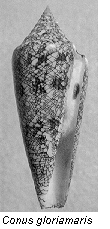
Kakombona on a sand slope, Wayne and I each found our first Conus
gloriamaris, and each was a gem, at 63' on a sandy slope! There was also
Conus generalis, Strombus minimus, S. plicatus pulchellus, Casmaria
erinaceus, several colorful Phalium glaucum, and under a rusted
slab of sheet metal, a beautiful Chama pacifica.
The next morning we departed the Florida Islands and
returned to Guadalcanal. Then the collecting got good! That night, diving at
Kakombona on a sand slope, Wayne and I each found our first Conus
gloriamaris, and each was a gem, at 63' on a sandy slope! There was also
Conus generalis, Strombus minimus, S. plicatus pulchellus, Casmaria
erinaceus, several colorful Phalium glaucum, and under a rusted
slab of sheet metal, a beautiful Chama pacifica.
On the 18th, we went back near the Lungga River mouth and put on tanks to
dive the silted poor-visibility slope in search of logs to push our hands under
while hoping to avoid the dangerous fins of the Butterfly Cod. This hardest
dive, physically, was worth it. Karlynn and Homer each found a Conus
gloriamaris under the same log, and the specimens were larger than the two
that Wayne and I had found.
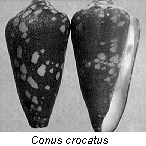 That night, and the next, we dove Mamara Point and had
our best finds of the trip. Between Wayne and me, we found five Conus
crocatus, in among dead coral fingers, three of which were giants over
60mm. The other three divers found Conus bullatus, while I collected
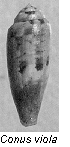
Conus viola, C. circumcisus, C. legatus, C. litoglyphus, C. muriculatus
sugillatus. C. imperialis, C. omaria and other cones, all in the same coral
habitat as the C. crocatus. I also found there a large 21mm
Psilaxis (syn: Philippia) radiata, Coralliophila
admirantium, Vexillum zelotypum and more. Between these night dives, we
day-snorkeled off downtown Honiara where the best shell was found by Karlynn, a
nice, large Conus varius, sitting on a coral head right by the downtown
seawall.
That night, and the next, we dove Mamara Point and had
our best finds of the trip. Between Wayne and me, we found five Conus
crocatus, in among dead coral fingers, three of which were giants over
60mm. The other three divers found Conus bullatus, while I collected
Conus viola, C. circumcisus, C. legatus, C. litoglyphus, C. muriculatus
sugillatus. C. imperialis, C. omaria and other cones, all in the same coral
habitat as the C. crocatus. I also found there a large 21mm
Psilaxis (syn: Philippia) radiata, Coralliophila
admirantium, Vexillum zelotypum and more. Between these night dives, we
day-snorkeled off downtown Honiara where the best shell was found by Karlynn, a
nice, large Conus varius, sitting on a coral head right by the downtown
seawall.
We were to depart from Fiji on the morning of June 21st, so the 20th was
spent packing and transferring our gear from the boat to a hotel. Karlynn and I
made one last night dive at the nearby Point Cruz on a reef down to 75'. There
was Lyrocardium lyratum, fresh dead on reef sand, a 6.5 inch black
hammer oyster, Malleus malleus, my first Cymatium lotorium, Conus
emaciatus, C. vexillum, and we each found Conus circumcisus.
This was the second trip to the Solomons for Wayne and me, both of them with
Brian Bailey aboard the Wyuna. We found many species on this trip that
we did not find on the first, and bigger and better specimens of some of the
species we found on the first trip. Brian is THE expert, and if (I say IF) his
boat and compressor are in working order, any shelling trip with him as a guide
is sure to be a success.
All photos were taken by Charlotte Lloyd.
[Top of
Page] - [AmConch
Index]

This is an official COA Conch-Net Web Page
hosted
by the Academy of Natural Sciences, Philadelphia. |
| COA
Contact |
Page
Curator |
Credits
|
Created: 15 August 1997; Last modified: 14
September 1998
This page has been accessed [an error occurred while processing this directive]times since 2 September 1997.
|